Less secondary media
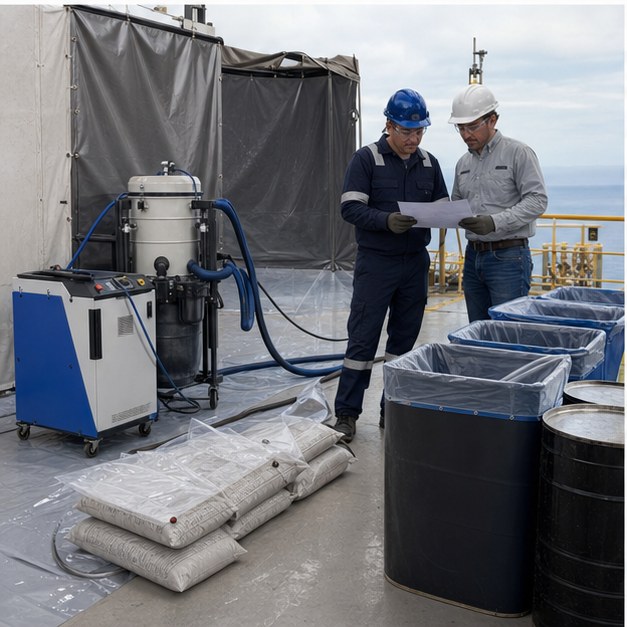
Suitable laser-cleaning scopes avoid introducing blasting grit or other expendable cleaning media. Removed material still requires controlled capture, classification and disposal.
Sustainability
Compare the complete work package—inputs, containment, waste, logistics and the outcome required from the surface.
Responsible application
Laser cleaning can offer a more focused route for suitable offshore surface-preparation tasks, particularly where abrasive-media handling, chemical use or extensive local clean-down would otherwise dominate the work package.
It is not impact-free. Electrical demand, extraction, filtration, PPE, mobilisation and disposal of the removed material still matter. PICSA’s position is to compare credible alternatives against the same defined scope and acceptance requirement.
PICSA-specific environmental claims and reduction percentages will be published only when supported by controlled project or trial data.
Suitable laser-cleaning scopes avoid introducing blasting grit or other expendable cleaning media. Removed material still requires controlled capture, classification and disposal.
Close-capture extraction and a defined treatment zone may reduce the scale of sheeting, clean-down and media recovery required for local work.
Controlled parameters can target a local coating, oxide or residue while limiting unnecessary treatment of adjacent retained surfaces.
The process does not add cleaning water or chemical stripper to the workface, although power, cooling, filtration and waste impacts remain part of the assessment.
Method comparison
Indicative characteristics for early screening. Final selection depends on the material, layer, area, access, required finish and site controls.
| Factor | Laser cleaning | Abrasive blasting | Chemical stripping |
|---|---|---|---|
| Consumables | No abrasive cleaning media; filters and protective consumables remain | Abrasive media and associated handling | Chemical product, neutralisation and absorbents may be required |
| Waste stream | Captured removed layer, particulates and spent filters | Removed coating plus spent abrasive media | Removed coating, chemical residue and contaminated liquid/absorbents |
| Containment | Often focused around a local controlled area | Frequently broad to contain overspray and recover media | Designed around splash, vapour, drainage and chemical contact |
| Water use | Normally no process water at the treatment point | Method-dependent; dry blasting may not use process water | Method-dependent; rinsing and neutralisation may add water |
| Best-fit pattern | Localised, selective or complex work after qualification | Large areas and specified abrasive profiles | Coatings suited to chemical removal and accessible dwell time |
Evidence framework
The market-analysis review calls for quantified value metrics and defensible validation. These are the inputs PICSA should capture to support future sustainability and whole-cost claims.
Start a conversation